
I’m researching a family for a client who is looking for an American Revolutionary Patriot. Her research project started on an island in GA when I met her and her friends feeding the turtles off a bridge. My son and I joined the group of women and shared our frozen peas while my son [all-knowing at a whopping 7 yo] explained to ‘his elders’ how bread is not good for wild animals. I struck up a conversation with her and we got talking about genealogy and DAR. She wondered out loud if her family had a patriot, so I offered to look. This post is about a man named Jeremiah who had a daughter named Harriet, who obviously had a mother, and the process of how I determined which woman was THE ONE.

Genealogy research is a lot of “OOOH Look” moments – that can pull your attention away from the main focus to something that is REALLY INTERESTING, but doesn’t answer the question you’re trying to answer. These moments are called rabbit holes; akin to the hole Alice fell into in the book “Alice in Wonderland”. Jeremiah is today’s ‘rabbit hole’.
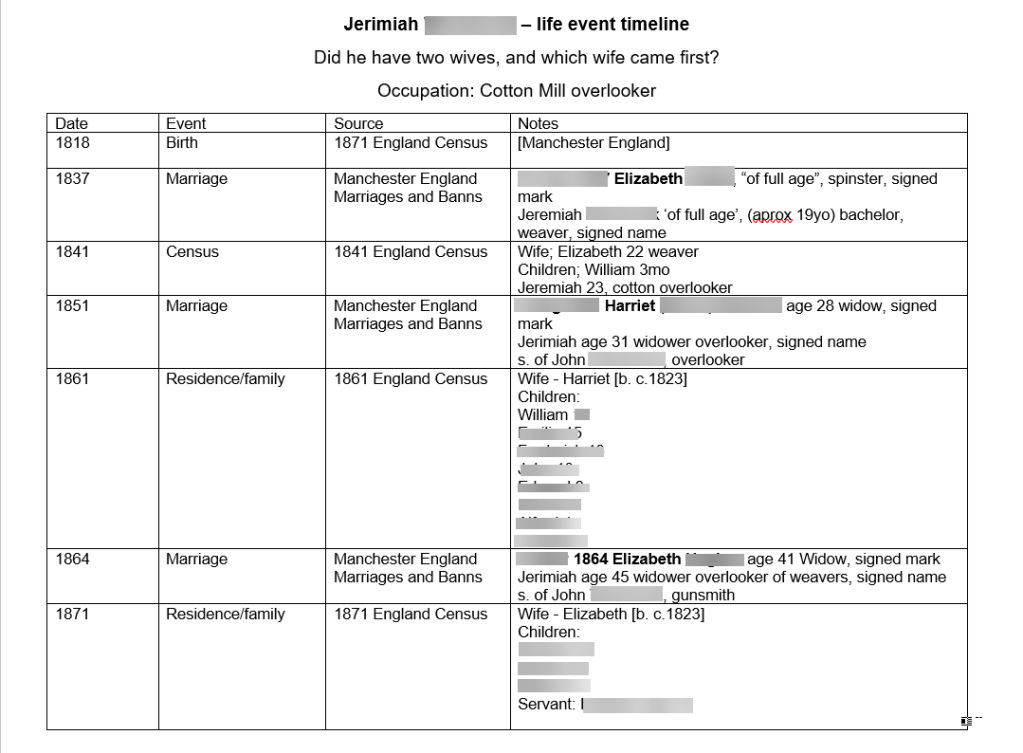
In order to determine who Harriet’s mother was I first I needed to determine Jeremiah’s milestones, so I could find his wife. An easy way to do this is by using census records, and making a timeline. I use tables in a word document to make a timeline so I can easily see a framework of someone’s life and make notes about each source document I find.
I searched England Census records and first found him in the 1871 census, with wife Elizabeth, daughter Harriet and two other children. I started the grid and wrote in the census information for the four people, along with the approximate birth year for Jeremiah based on his age in 1871.
Then wanting to see where they they were 10 years earlier I searched for the 1861 census. Jeremiah and his wife Harriet are listed in this census with 8 children, only three of which are named in the 1871 census. Calculating the birthdates of the women based on their ages on the census told me they were both born about 1823. I added all the people to my grid on a new line dated 1871 and continued. Going back in time again, I was unable to find him in 1851, but did find him in the 1841 census, with his wife Elizabeth and a 3 month old son. Now my scaffolding has an estimated birth date and three other date points with which to compare the marriage record data.
As I reviewed the marriage records I knew I had the same man in all three records. The groom’s father’s name and occupation were either the same or similar in all three, along with the occupation of the groom himself. I added in the information to the timeline and the big picture started to emerge.
PHEW! This man had an eventful 34 years between 1837 and 1871. His first marriage was in 1837 to a single woman (aka spinster) “of full age” (over 18 I believe) named Elizabeth. He had at least three children with her, maybe four, based on their birth dates and his marriage dates.
In 1851, he married for a second time to a 28 year old widow named Harriet, who signed her name with a mark on their marriage certificate. Together they had four, maybe five, children – based on the 1861 census entry.
He then married another widow, Elizabeth age 41 – who also signed with a mark – in 1864. I do not believe they had any children together as the three children listed in the 1871 census had also been listed in the 1861 census.
All three of these women were born about 1820 (-/+ 3 years) and were not able to write or sign their own name. His occupation consistently was working in a cotton mill environment: first as a weaver, then as a cotton overlooker, then as a overlooker of weavers. He had a total of (so far) eight children, of which one may have died early as there are no further records of Jeremiah’s youngest son.
Using a timeline is one of the best tools I have in my tool box to help me analyze a data. I’m able to get a big-picture of their life and how other individuals weave in and of of the main subject’s life, and not be distracted by the plethora of small details that always pop up. Timelines can be your best friend when trying to figure out who, what, where and why someone in the past did what they did. Sometime in the future, I’ll write another example of how a timeline helped a Canadian find their US born Great-Grandmother Dora, and my theory of why no one knew the story of Dora’s early life.
 Tracing My Tree, Finding My Roots
This is so interesting. I admire you for being so interested and sticking with a story line. It must be hard at times but so rewarding when you discover such interesting information. You are a Rock Star!!
Thanks for the compliment! It can be hard, but the rewards are SO AWESOME! Putting together the pieces to see the whole story, and then telling or showing it to the people who asked me to help is one of the best feelings.